

Skateboard Graphics & Skate Art: A Visual History
A skateboard is more than a piece of wood on four wheels. For decades, it has served as a canvas for illustrators, graphic designers and artists, giving rise to a distinctive visual culture rooted in creativity, rebellion and self-expression.
From the earliest logos printed on wooden decks to the iconic skateboard graphics of the 1980s and 1990s, artwork has become an essential part of skateboarding’s identity. Skulls, monsters, cartoon characters, experimental typography and contemporary illustrations have helped define generations of brands and skateboarders. But skateboard art extends far beyond printed graphics. Painters, sculptors, street artists and designers have gradually adopted the skateboard as an artistic medium in its own right, transforming decks into sculptures, installations, furniture and collectible artworks.
This is where skateboard graphics meet skate art: two closely connected forms of expression, one rooted in skateboarding culture and the other exploring the skateboard as an object of contemporary art. Since 2011, The Daily Board has documented this creative universe through illustrated skateboard collections, artist interviews, exhibitions and original projects.
A Brief History of Skateboard Graphics
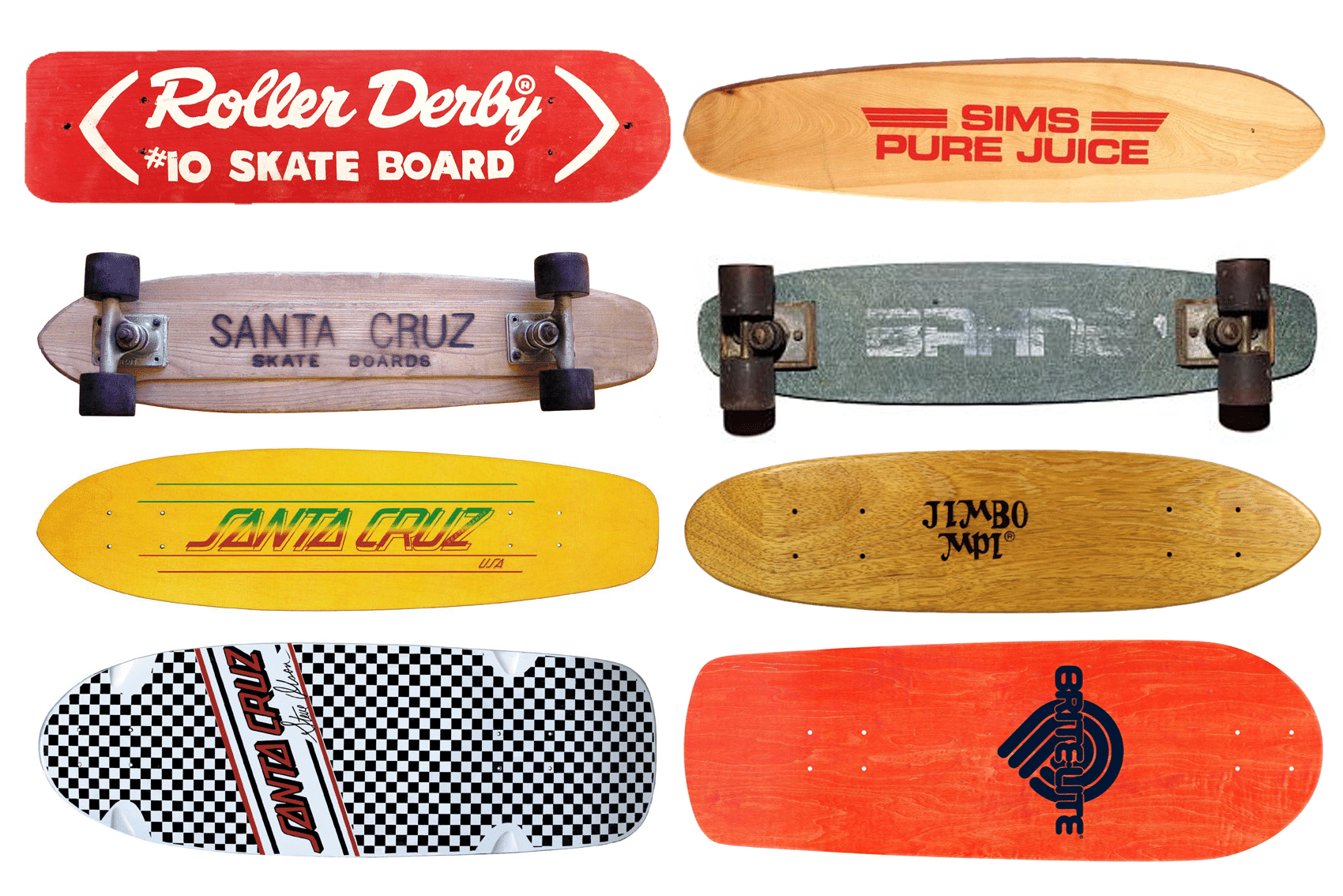
1950s–1970s: From Wooden Boards to the First Graphics
During the early development of skateboarding in the 1950s, many skateboards were relatively simple wooden boards fitted with wheels. Their appearance was primarily functional, although manufacturers gradually began to use colors, logos and printed designs to distinguish their products.
As skateboarding gained popularity, commercial manufacturers such as Roller Derby helped establish recognizable skateboard products. The brand’s early boards featured printed lettering, reflecting the growing importance of visual identity in an emerging industry.
The 1970s marked a turning point. Skateboarding was evolving in California, where surf culture, emerging skate teams and independent companies encouraged new approaches to equipment and design. Skateboard graphics gradually moved beyond simple branding to become a means of expressing the identity of a team or rider.
The Dogtown Cross, associated with Wes Humpston, Jim Muir and the Dogtown scene, became one of the defining examples of this transition. Its striking visual language demonstrated how even a relatively simple graphic could carry a powerful cultural identity.
By the end of the decade, graphic design was becoming an increasingly important part of the skateboard itself.
1980s: The Golden Age of Skateboard Illustration
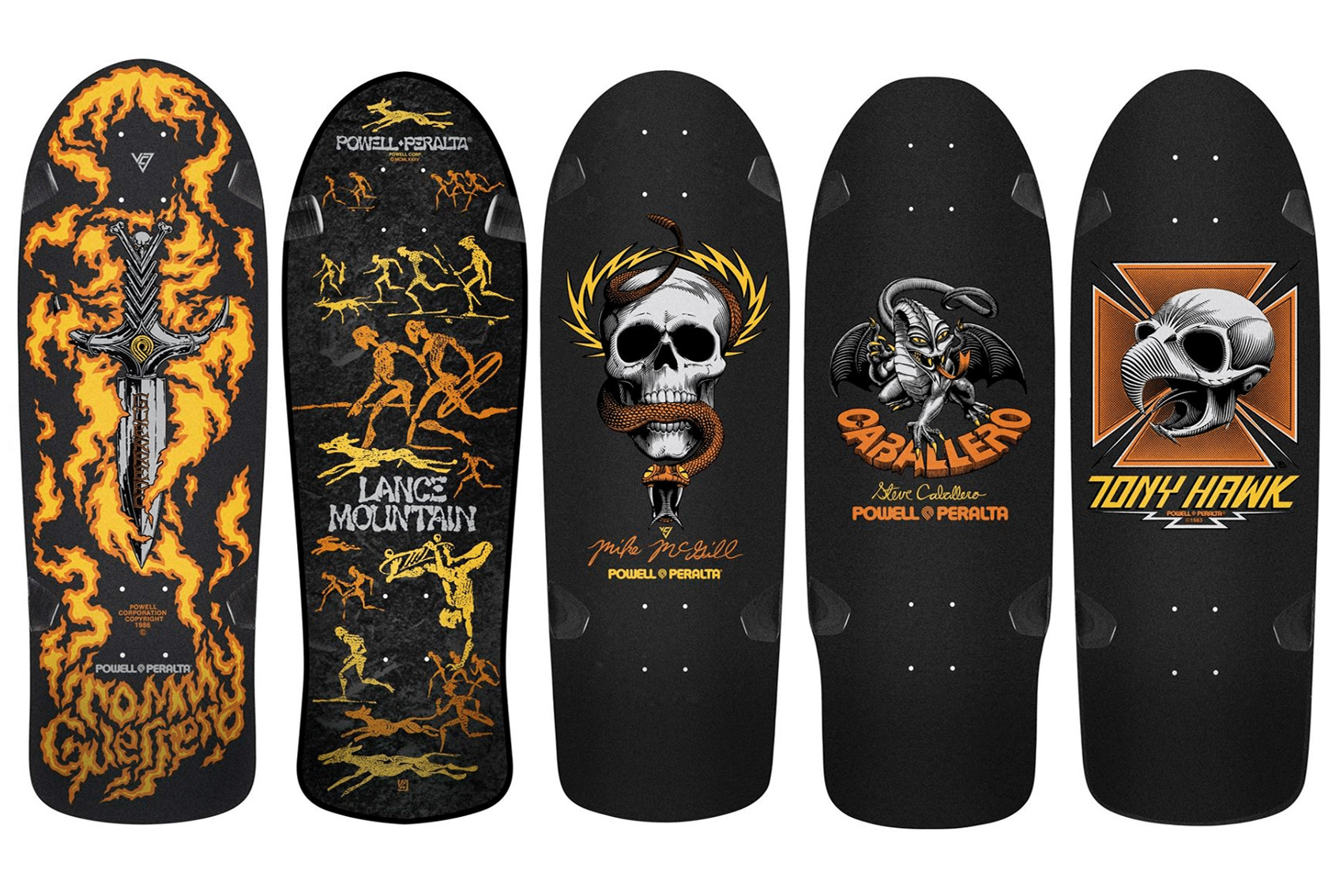
The 1980s saw skateboard graphics develop into a particularly expressive form of illustration. As skateboarding expanded, brands began producing increasingly elaborate artworks that drew inspiration from punk rock, heavy metal, horror films, comic books and Southern California’s hot rod culture.
Artists such as Jim Phillips, Vernon Courtlandt Johnson and Wes Humpston helped shape this visual revolution. Their work introduced memorable characters, detailed drawings and symbols that became closely associated with individual riders and skateboard companies.
At Santa Cruz Skateboards, Jim Phillips developed an unmistakable style combining exaggerated characters, vivid colors and influences from underground illustration. His iconic Screaming Hand, introduced in 1985, became one of skateboarding’s most recognizable images.
Meanwhile, Vernon Courtlandt Johnson, also known as VCJ, created influential graphics for Powell Peralta. His illustrations, including the famous skull and sword imagery associated with the Bones Brigade, contributed to the dark and fantastical aesthetic of the period.
Skateboard decks were no longer simply branded sporting equipment. Their graphics had become objects of identification, visual storytelling and personal expression.
1990s: Provocation, Cartoons and Creative Freedom
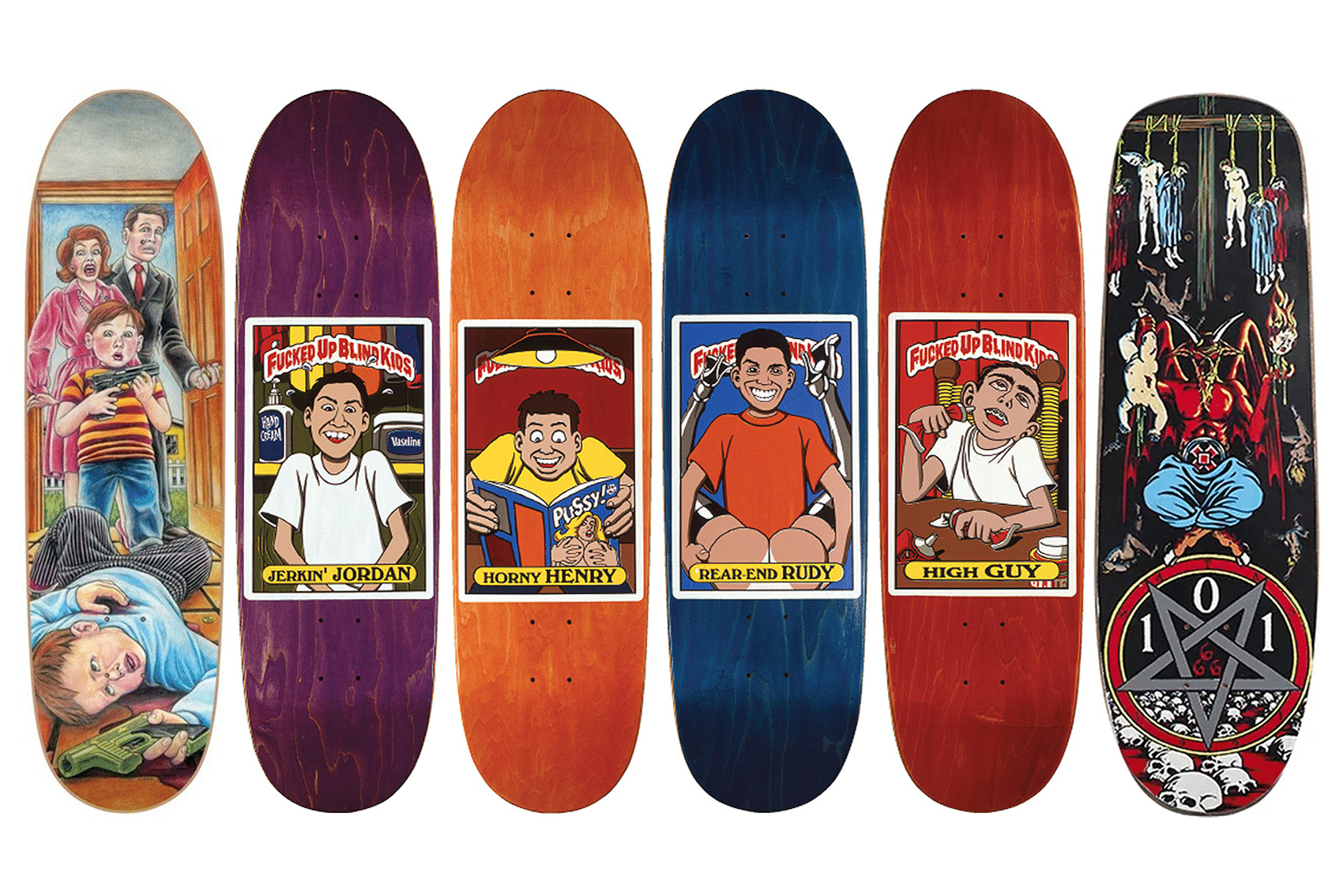
The rise of street skateboarding in the late 1980s and early 1990s brought major changes to the industry and its visual culture. A new generation of companies challenged established conventions with graphics influenced by cartoons, popular culture, satire and deliberately provocative humor.
Marc McKee and Sean Cliver became important figures in this period, creating memorable illustrations for brands associated with the World Industries universe, including Blind and 101.
Their graphics often questioned social conventions, parodied familiar imagery and embraced controversy. The relationship between the professional skateboarder and the graphic artist also became increasingly significant, with individual deck designs reflecting a rider’s personality, humor or cultural references.
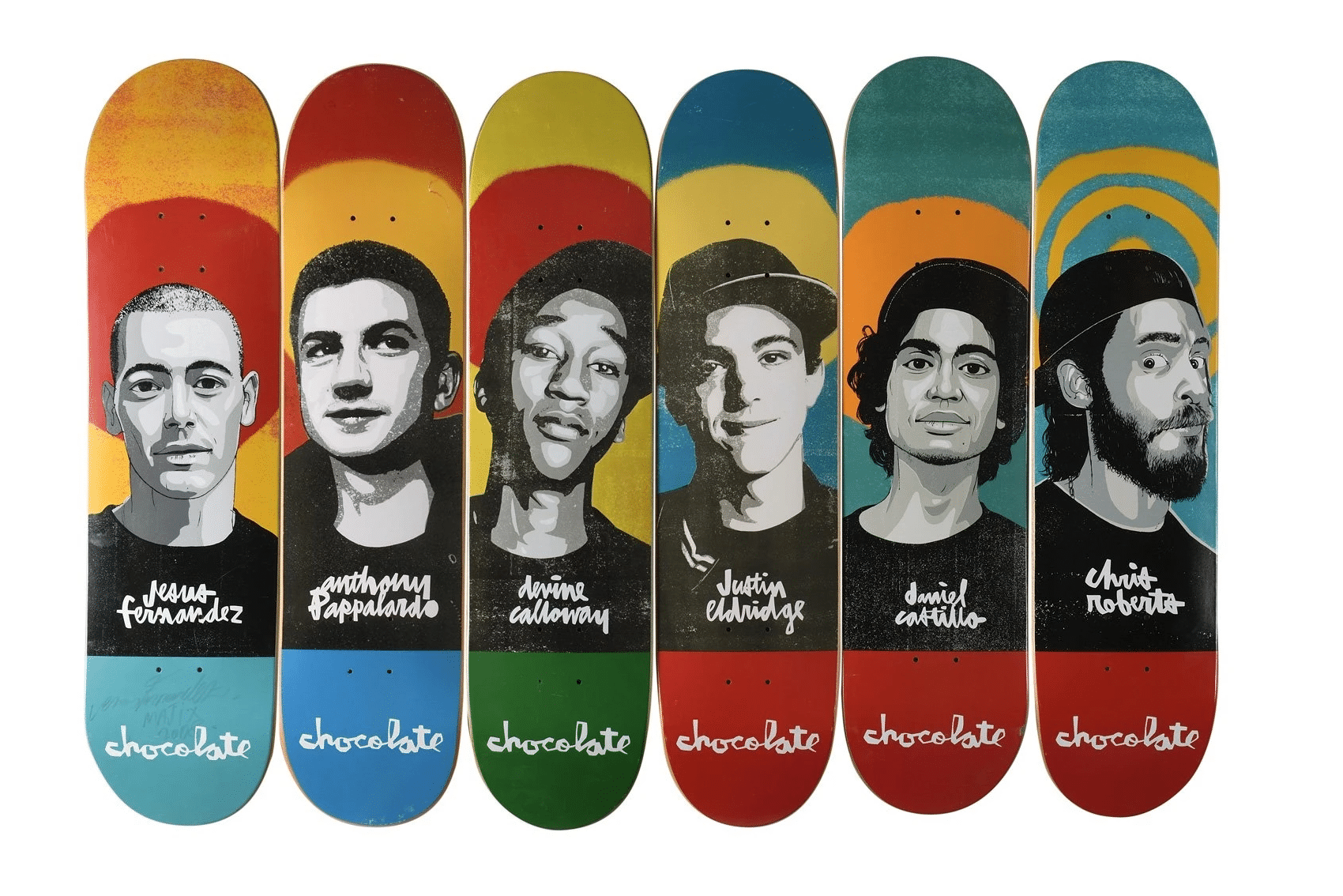
The decade also saw the emergence of new approaches to branding. Founded in 1993, Girl Skateboards developed a particularly influential visual identity around its minimalist female silhouette logo, while Chocolate Skateboards explored a complementary creative universe.
Under the direction of artists and designers such as Andy Jenkins, skateboard graphics became a field of ongoing experimentation, combining illustration, photography, typography and conceptual design.
2000s: Graphic Diversity and the Growing Connection with Contemporary Art
At the turn of the 2000s, skateboard graphics continued to diversify as brands developed increasingly distinctive visual identities. While provocative illustrations and cartoon-inspired characters inherited from the 1990s remained prominent, new approaches incorporated photography, typography, collage and references to contemporary art.
This period brought together remarkably contrasting graphic styles. Brands such as Zero, Darkstar and Creature Skateboards cultivated dark aesthetics influenced by horror films, punk rock and heavy metal. Meanwhile, Girl and Chocolate continued experimenting with graphic design, illustration and photography, while Element developed a visual identity closely associated with nature, environmental themes and different forms of artistic expression.
The relationship between skateboarding and contemporary art also became increasingly visible. In 2004, the Beautiful Losers exhibition at the Contemporary Arts Center in Cincinnati highlighted a generation of artists connected to skateboarding, graffiti and DIY culture, including Ed Templeton, Barry McGee and Thomas Campbell. At the same time, collaborations between skateboard brands and contemporary artists contributed to a changing perception of skateboard decks, which were increasingly appreciated as creative surfaces and collectible objects.
2010s: The Rise of Independent Brands and Artist-Driven Identities
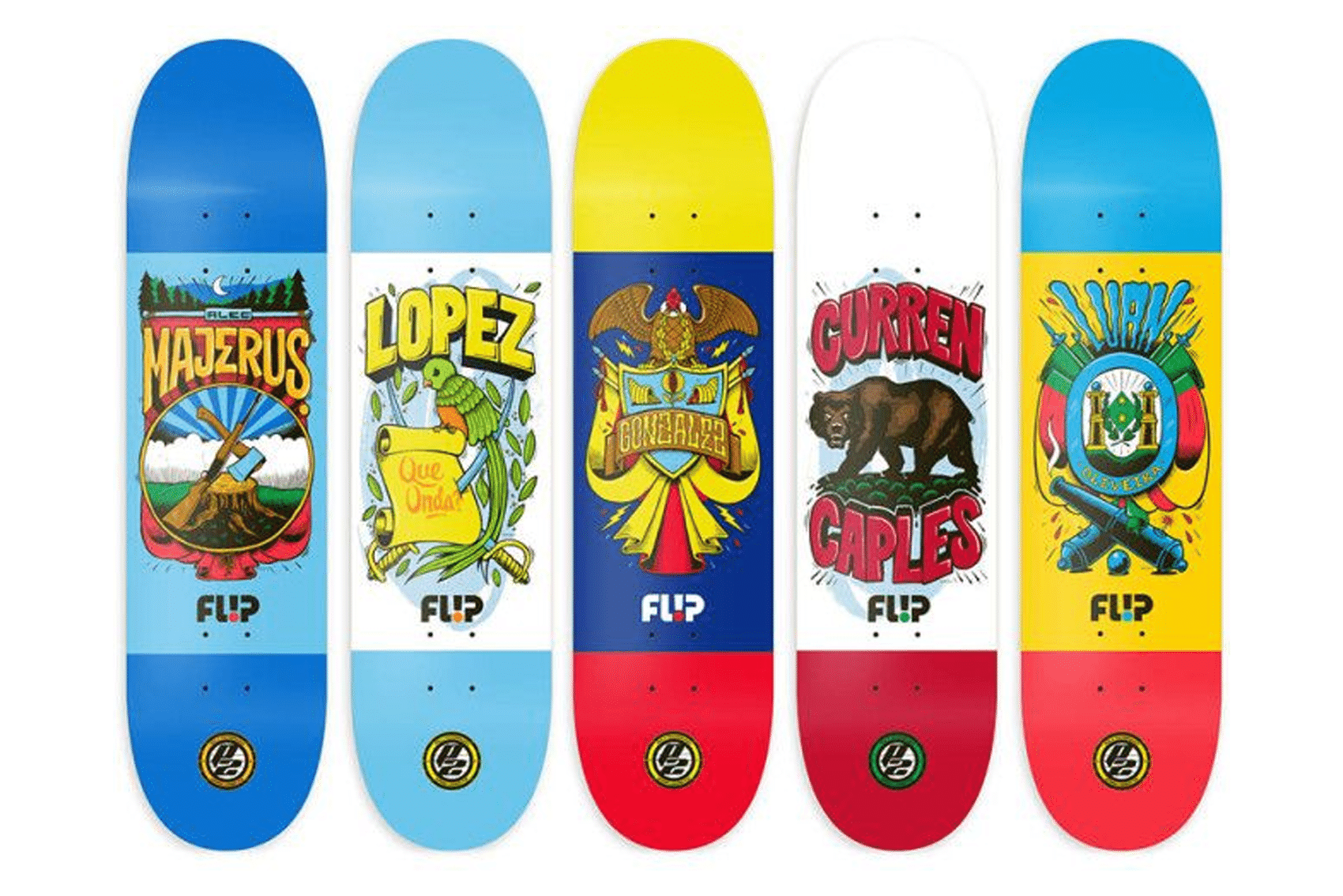
The 2010s marked another important chapter with the emergence of independent brands that developed distinctive visions of skateboarding closely connected to their artistic identities. In Europe, Palace Skateboards in London, Magenta Skateboards in Bordeaux and Polar Skate Co. in Malmö helped reshape the landscape, creating visual universes that extended far beyond the graphics printed on their decks.
At Palace, the brand’s identity was built around its iconic triangular logo designed by Fergus Purcell, alongside an aesthetic combining popular culture, humor and British street culture. Magenta developed an illustration-driven visual language rooted in a personal interpretation of street skateboarding, while Polar, founded by Pontus Alv, established close connections with drawing, independent filmmaking and visual experimentation.
Other companies, including Isle Skateboards, founded in 2013, explored the boundaries between contemporary art and skateboarding. Through photography, installations and conceptual graphic compositions, Isle developed an artistic identity in which skateboard graphics became extensions of a broader creative practice.
The growth of social media and digital platforms also made it easier for independent brands and illustrators to share their work internationally. Artists could present their creations directly to audiences around the world, while collaborations between brands and creative practitioners became increasingly visible. Skateboard decks offered an accessible medium for circulating images between different artistic communities without depending exclusively on the industry’s largest established companies.
2020s to Today: Artistic Collaborations and New Forms of Skateboard Art
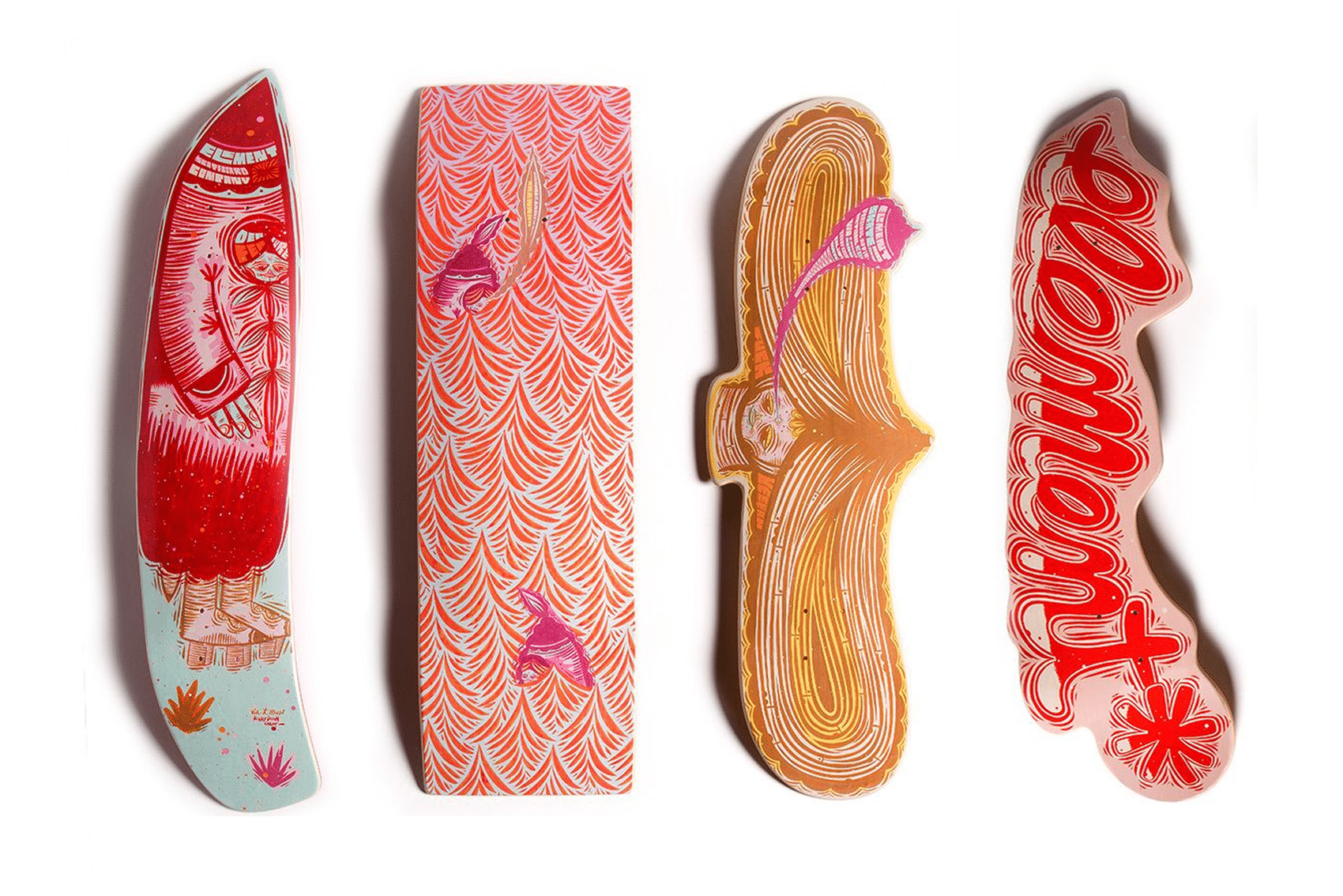
Since the beginning of the 2020s, skateboard graphics have continued to evolve in an environment where the boundaries between illustration, graphic design, fashion and contemporary art have become increasingly fluid. Artistic collaborations, already well established in previous decades, remain an important way for skateboard brands to explore new visual directions and connect different creative communities.
Artists now have numerous possibilities for experimenting with skateboard decks as a medium. Beyond conventional printing, laser engraving, painting, collage, mixed media and direct manipulation of wood offer alternative approaches to decorating and transforming boards. Some creators focus on limited editions and one-of-a-kind pieces, appealing to skateboard enthusiasts as well as collectors of graphic art.
Skateboarding’s presence in the art world is also reflected in exhibitions, auctions and projects involving artists, galleries and cultural institutions. This evolution does not mean that every skateboard deck should be considered an artwork, but it highlights a broader interest in the aesthetic, historical and creative dimensions of skateboard graphics.
In an era when images circulate instantly around the world, the skateboard retains a distinctive position: a functional object that has become one of the most recognizable surfaces in contemporary graphic culture. Between the legacy of established brands, the creativity of independent companies and ongoing artistic experimentation, skateboard graphics continue to reinvent themselves.
The Artists Behind Skateboard Graphics
The history of skateboard graphics is inseparable from the artists who created them. Although professional skateboarders and brands often receive most of the attention, the illustrators and art directors working behind the scenes have played an essential role in defining skateboarding’s visual identity.
Jim Phillips, Vernon Courtlandt Johnson, Marc McKee and Sean Cliver are among the influential figures whose work helped establish the visual vocabulary of skateboard graphics. Their illustrations have become recognizable far beyond the individual decks on which they originally appeared.
Other creators, including Andy Jenkins, Evan Hecox and Mark “Fos” Foster, have contributed distinctive approaches to graphic design, from experimental illustration and photography to hand-drawn characters and unconventional typography.
Their work demonstrates that skateboard graphics cannot be reduced to a single artistic style. Rather, they form a constantly evolving visual language shaped by the relationship between artists, skateboarders and the brands that bring their ideas to life.
Through its Behind Boards interviews, The Daily Board explores these creative processes directly with the artists and art directors responsible for some of skateboarding’s most distinctive imagery.
From Skateboard Graphics to Contemporary Skate Art
While skateboard graphics are generally designed to decorate functional decks, skate art extends the creative possibilities of the skateboard beyond its original purpose.
Artists may paint directly onto a deck, engrave its surface, reinterpret its shape or transform used skateboard wood into entirely new objects. In these works, the skateboard becomes more than a support for an image: its material, history and physical characteristics become part of the artistic process.
Japanese artist Haroshi is a prominent example of this approach. By assembling and carving discarded skateboard decks, he creates sculptures that reveal the colored layers of laminated wood. The material retains traces of its former life while acquiring a new sculptural identity.
Other artists approach the skateboard as a canvas, experimenting with painting, illustration, collage or mixed media. Some preserve the familiar silhouette of the deck, while others use its shape as a starting point for entirely different constructions.
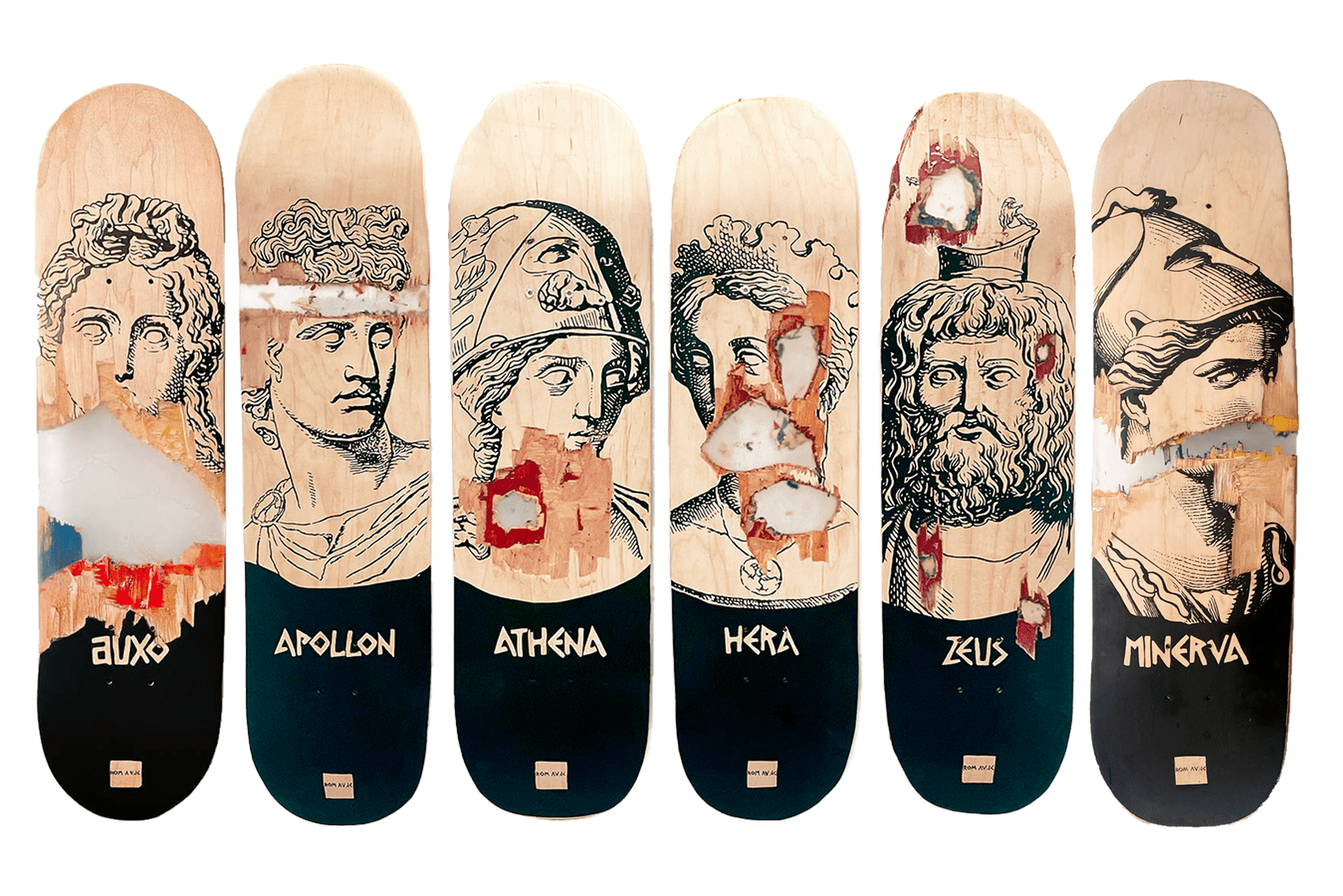
Among these approaches, Rom av.JC explores an imagined connection between Greco-Roman antiquity and skateboard culture. Through sculptures and artworks made from broken skateboards, he creates fictional archaeological objects inspired by ancient ceramics, mythology and classical imagery.
These practices reveal how skate art can transform a familiar object into a medium for storytelling, material experimentation and contemporary artistic expression.
Les différentes formes de Skate Art
Les possibilités créatives offertes par les skateboards sont particulièrement variées. Bien que les frontières entre les disciplines restent souvent poreuses, plusieurs approches peuvent être distinguées.
L’illustration et le graphisme constituent les formes les plus directes de skate art. Les artistes utilisent le dessin, la peinture, la sérigraphie, la photographie et la typographie pour créer des images qui dialoguent avec les proportions et la silhouette de la planche.
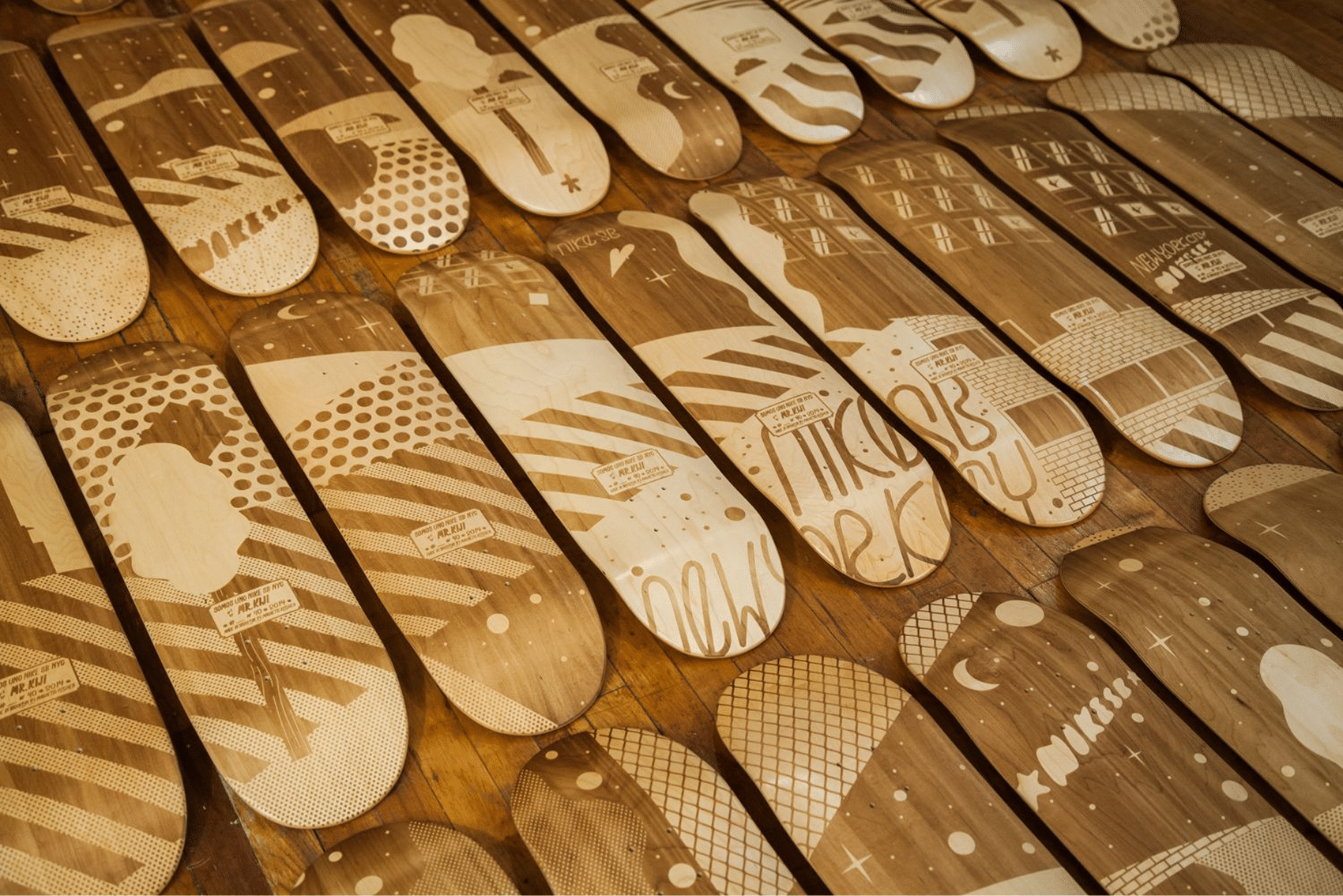
La gravure et le travail de surface proposent une autre manière d’aborder le bois. La gravure laser, la pyrogravure et les détails sculptés transforment directement la matière, créant des textures et des effets visuels différents de ceux des graphismes imprimés traditionnels.
La sculpture et l’assemblage éloignent davantage le skateboard de sa fonction initiale. Les artistes découpent, superposent, assemblent ou sculptent des planches usagées, exploitant les couches colorées et les qualités physiques du bois pour produire des œuvres tridimensionnelles.
Le mobilier et le design d’objet explorent le potentiel fonctionnel du matériau. Les planches peuvent être transformées en sièges, tables, luminaires, objets décoratifs et autres créations qui réinterprètent leur silhouette familière.
Enfin, les installations et les œuvres contemporaines utilisent les skateboards comme éléments de compositions plus vastes, abordant des sujets allant de la société de consommation et de l’identité urbaine à la mémoire, au recyclage ou à l’artisanat.
Ces différentes démarches démontrent que le skate art ne se définit pas par une technique unique. Il constitue un vaste champ de pratiques créatives réunies autour d’une forme, d’une matière et d’une histoire culturelle communes.
Explorer le Skate Art sur The Daily Board
Depuis plus d’une décennie, The Daily Board explore les relations entre la culture skateboard et la création artistique.
Découvrez les identités graphiques des grandes marques de skateboard, les collections de planches illustrées et les artistes qui façonnent cette culture visuelle à travers nos interviews exclusives.
Des illustrations historiques aux sculptures contemporaines, The Daily Board met en lumière la créativité qui continue de transformer les skateboards en œuvres d’art.